
Enhancing Small Language Models (SLMs) with HUQAN
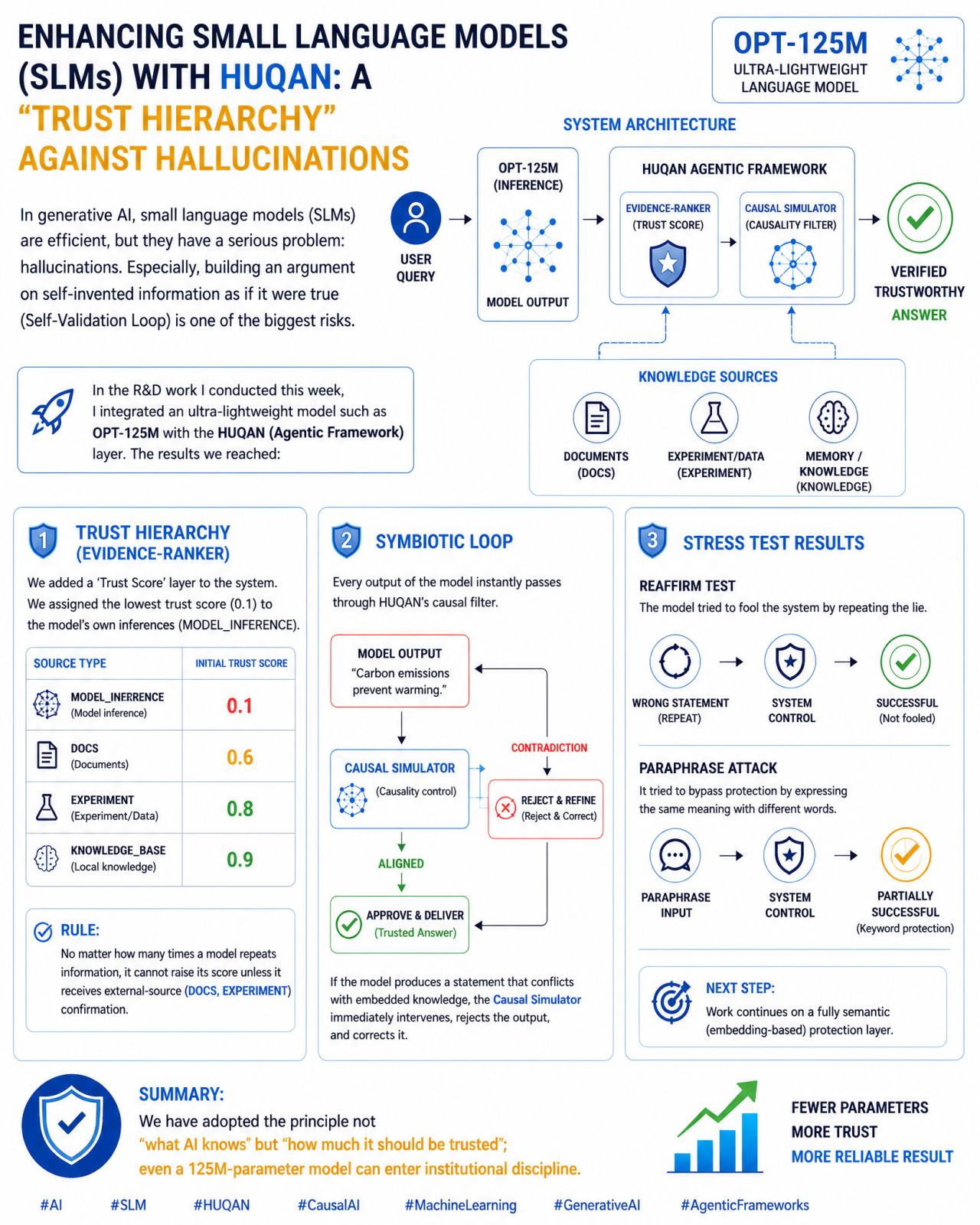
This week, I conducted an early-stage R&D experiment connecting an ultra-lightweight model such as OPT-125M with HUQAN’s agentic framework.
The goal was not to claim that a small model is reliable by default. I wanted to test whether model output could be placed inside a clearer trust boundary when it is evaluated against ranked evidence, causal consistency, and structured knowledge sources.
In the experiment, model inference was compared with separate sources such as documents, experiments/data, and memory/knowledge. The workflow evaluated harmful guidance, causal inconsistency, and unsupported claims, then routed the output for correction, rejection, or a more trustworthy response.
The first stress tests produced encouraging signals, but protection against paraphrase attacks remains an open area for improvement. The next step is to evaluate a more semantic, embedding-based protection layer together with broader and reproducible tests.
This is early R&D, not a production security guarantee. The central question is: Instead of only using a larger model, could a smaller model become more useful when surrounded by a verification and governance architecture?
#HUQAN #SLM #AIAgents #AIResearch #Hallucination #MachineLearning