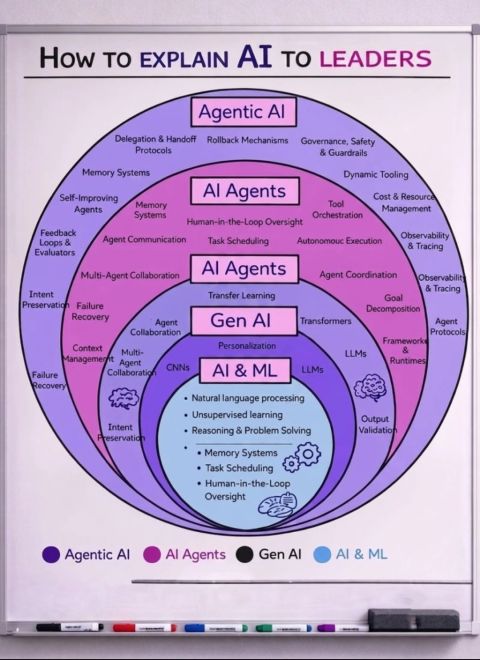


How to explain agentic AI to your leadership team:
It's not one, single tool.
It's layers of capability.
Here are 5 levels that will determine who wins in 2026:
1/ Machine Learning:
→ Turns data into decisions.
→ Forecasts sales, detects fraud, and can predict churn.
→ It can optimize pricing automatically.
→ Tools: AWS SageMaker, Google Vertex AI, Azure ML.
2/ Neural Networks & Deep Learning:
→ Complex pattern detection at scale.
→ Inspects quality with computer vision.
→ Powers voice commands and document processing.
→ Enables facial recognition systems.
→ Tools: TensorFlow, PyTorch, AWS Rekognition.
3/ Generative AI:
→ Generates content and code at scale.
→ Drafts marketing content and automates meeting notes.
→ Builds knowledge bases and generates code.
→ Creates product images instantly.
→ Tools: ChatGPT, Claude, Gemini, Midjourney.
4/ AI Agents:
→ Execute complex tasks autonomously.
→ Handle IT tasks and generate leads.
→ Process customer requests independently.
→ Research topics without human input.
→ Tools: LangChain, CrewAI, Microsoft Copilot.
5/ Agentic AI:
→ Networks of agents that collaborate autonomously.
→ Modernizes legacy software systems.
→ Builds AI into products seamlessly.
→ Orchestrates end-to-end processes.
→ Tools: Claude Code, OpenAI Codex, Devin.
Here's why this matters:
You can't skip the layers.
Each one builds on the previous.
Most companies are stuck at layer 1 or 2.
While their competitors race to layer 5.
Here's the difference:
→ Machine Learning analyzes and predicts.
→ Neural Networks recognize patterns.
→ Generative AI creates content and code.
→ AI Agents follow through and execute multi-step tasks.
→ Agentic AI manages entire processes.
Leaders who understand this stack will dominate 2026.
Those who don't will unfortunately be left behind.
#AI #VIVID #AgenticAI #BuildingInPublic