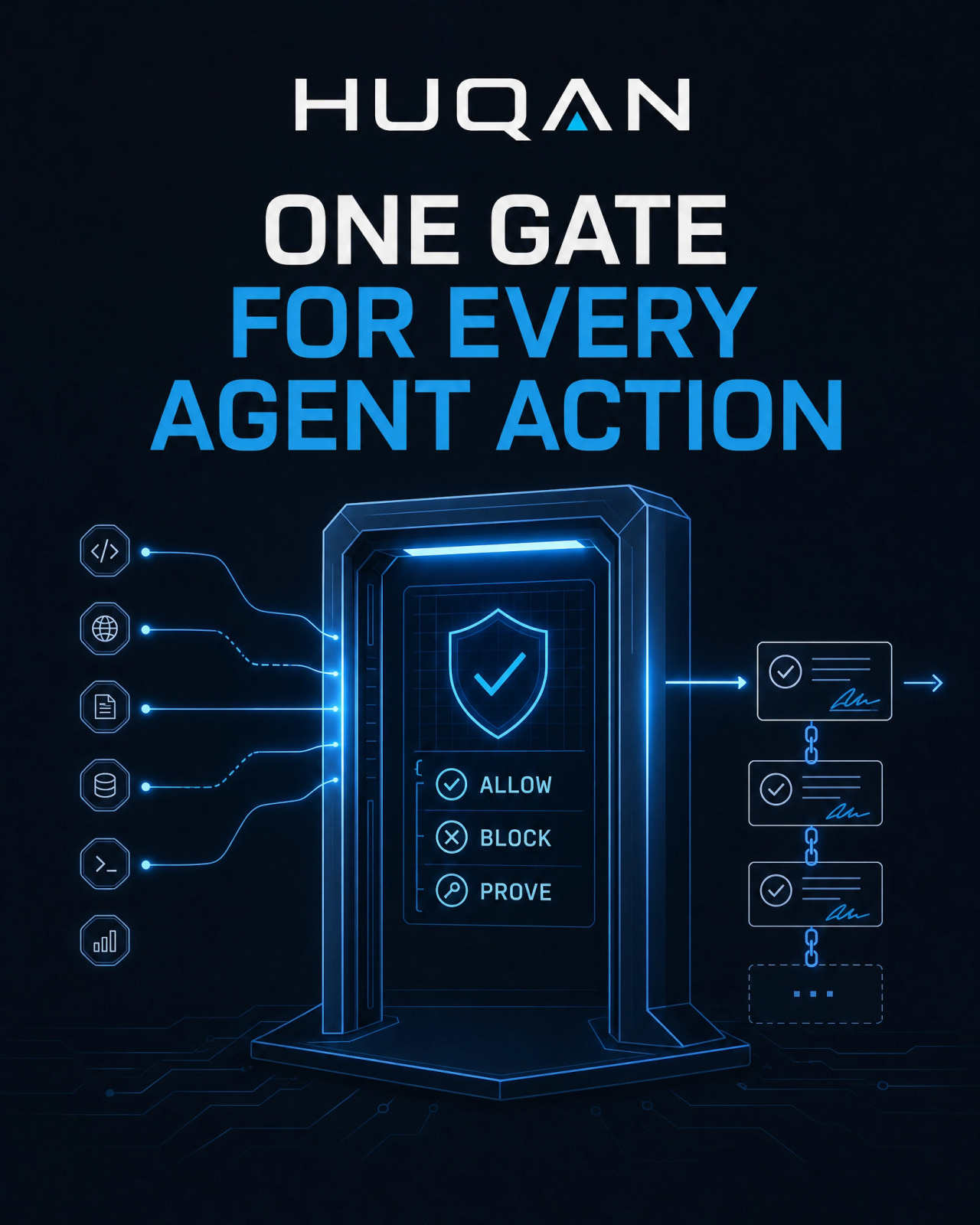


Over the last two days, HUQAN has been moving from a memory and graph layer toward an agent security layer.
The core idea is simple: before an AI agent runs a command, deletes a file, or sends a message to another agent, the action must pass through one control point. HUQAN either allows it or blocks it, and leaves behind a signed receipt.
What landed:
• A universal external action gate. Every external action is checked before execution.
• Agent-to-agent traffic now passes through the same gate. One agent’s action can be linked to another agent’s receipt.
• Persistent agent identity. The agent responsible for an action is recorded at the gate and in the receipt.
• Graduated autonomy. As trust falls, permissions narrow. As trust rises, they expand.
• Post-action anomaly quarantine. When behavior drifts, the agent is automatically restricted.
• The agent cannot disable its own gate👊. Writes to the gate’s control plane are blocked.
• Ed25519-signed capability cards. Receipts can be verified cryptographically, and the gate stays closed if signature verification fails.
• An installation pipeline that rejects unloadable installations, then loads and verifies valid ones in a separate process.
The result is a clear security boundary for agentic systems: identity, policy, autonomy, monitoring, and cryptographic evidence in one flow.
#HUQAN #AutonomousAgents